
Integrated Perimeter Security and Access Control Systems for Airports and Critical Infrastructure in KSA
Discover how integrated perimeter protection, intelligent surveillance, and access control technologies can help safeguard airports and critical infrastructure across Saudi Arabia.

Integrated perimeter security and access control systems provide a unified approach to protecting airports, government facilities, industrial sites, utilities, transportation hubs, and other critical infrastructure across Saudi Arabia.
Rather than operating as separate technologies, perimeter detection, intelligent surveillance, access control, automated gates, biometric authentication, and centralized security management work together to identify threats, control access, and enable rapid incident response.
As Saudi Arabia continues investing in smart infrastructure and Vision 2030 development, integrated security solutions are increasingly important for safeguarding people, assets, and high-value facilities while supporting operational efficiency and regulatory compliance.
What Does Integrated Perimeter Security Actually Mean?
Integrated perimeter security combines multiple security technologies into a centralized platform that continuously monitors, detects, verifies, and responds to potential threats.
Modern systems typically integrate perimeter intrusion detection sensors, CCTV surveillance, thermal cameras, AI video analytics, biometric access control, automatic gates, turnstiles, bollards, and centralized security management software.
By sharing information across connected devices, security teams can identify suspicious activity faster, verify incidents, and coordinate responses more effectively than with standalone systems.
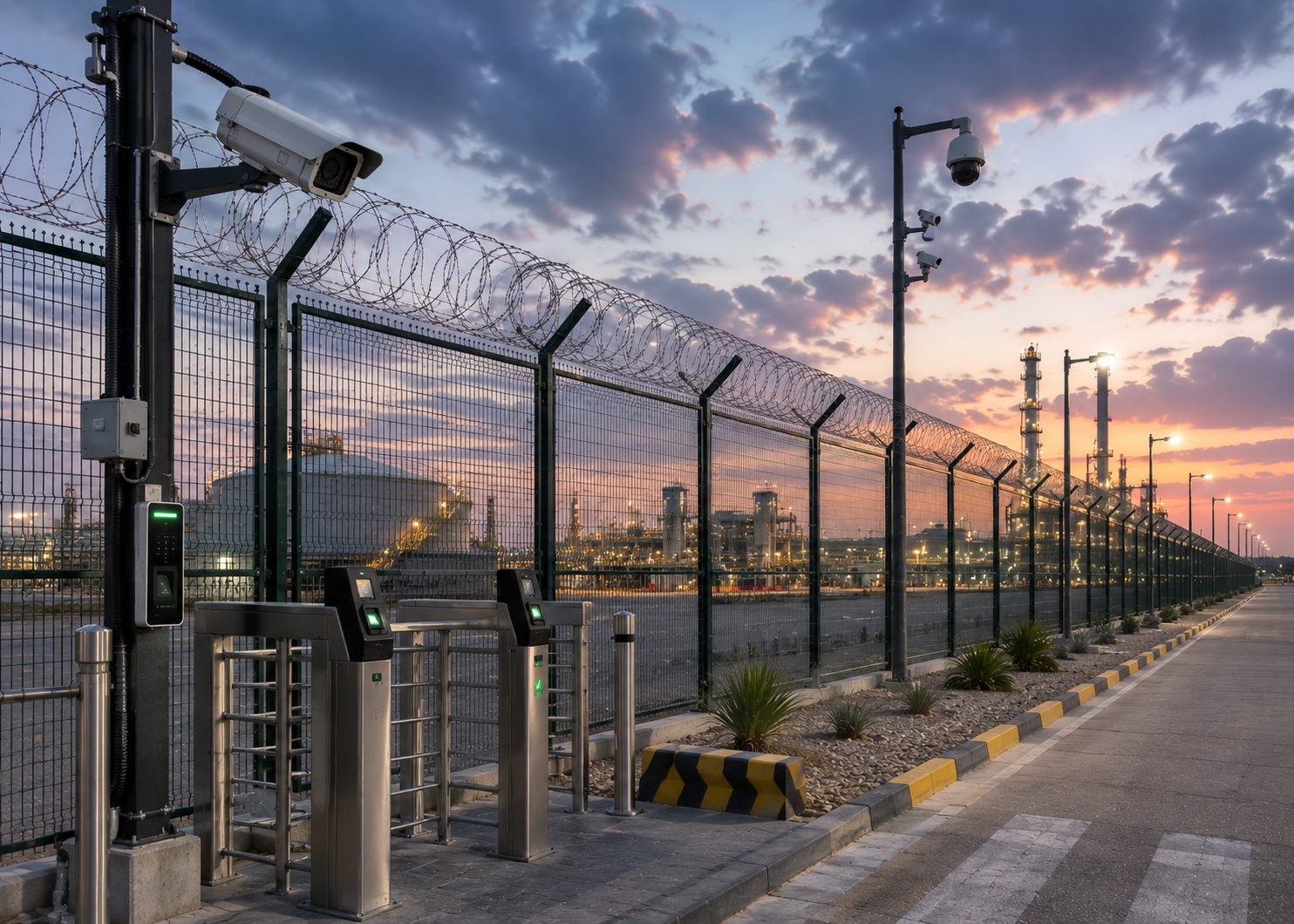
When a perimeter sensor detects an event, an integrated system can direct nearby camera views to the relevant location, notify operators, and apply configured response procedures through a connected security platform.
Why Airports Need This Level of Security
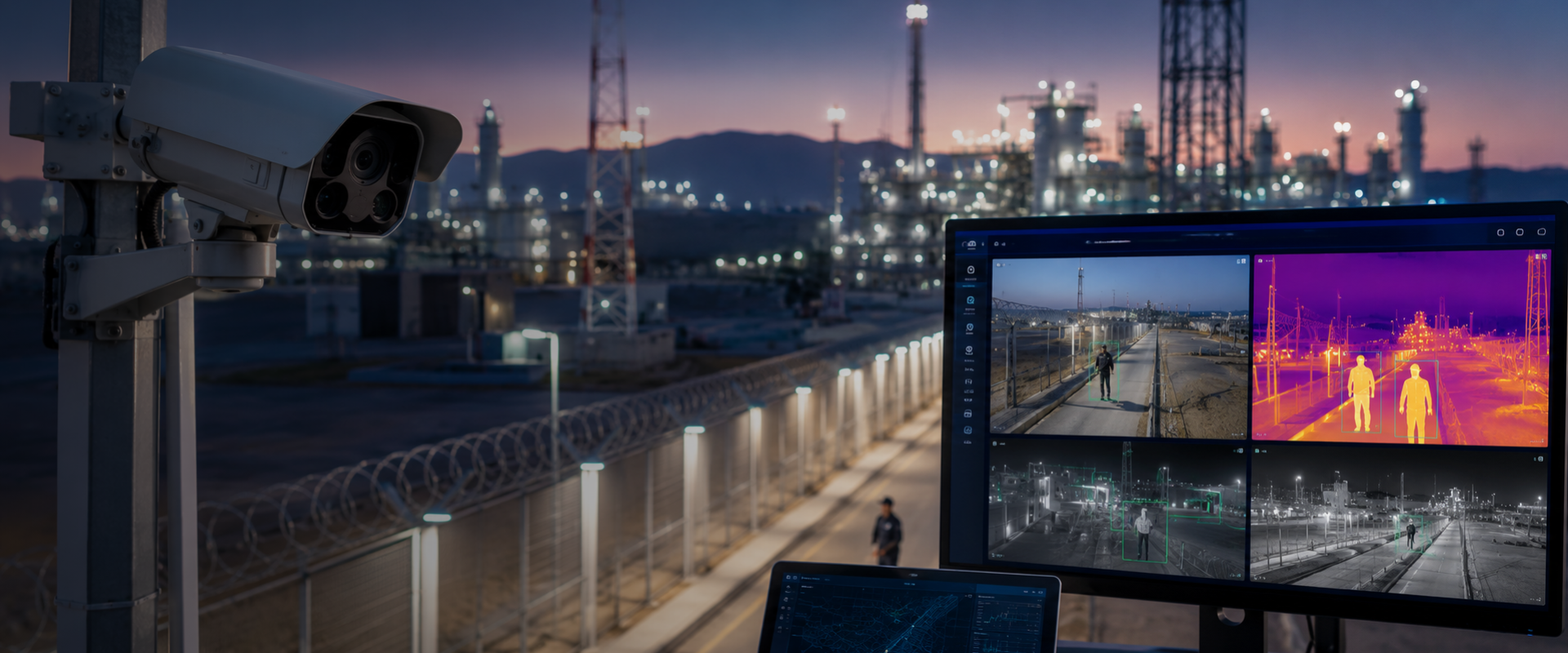
Airports represent some of the most security-sensitive environments in Saudi Arabia, requiring continuous monitoring of passenger terminals, cargo facilities, restricted zones, aircraft movement areas, maintenance facilities, and perimeter boundaries.
Integrated perimeter and access control systems help detect unauthorized access, monitor vehicle movements, verify personnel credentials, and support security responses according to established operating procedures.
These systems can also support operational visibility and help security teams coordinate their response to incidents.
A unified approach is particularly valuable where multiple entry points, restricted areas, contractors, service vehicles, and operational teams must be managed across a large facility.
Why Critical Infrastructure Faces Similar Demands
Power stations, desalination plants, telecom facilities, and water treatment sites all keep essential services running for entire cities. Security failures at these sites can disrupt operations, affect service delivery, and create risks for personnel and assets.
Integrated perimeter security helps protect these environments through coordinated monitoring, controlled access, and documented response procedures.
Secure Perimeters and Restricted Areas
Perimeter sensors and surveillance cameras can help detect unauthorized entry attempts and direct security teams to areas requiring attention.
Controlled Personnel and Vehicle Access
Access control systems can manage credentials, entry points, automatic gates, turnstiles, and vehicle barriers according to defined permissions.
Centralized Security Monitoring
A central management platform can combine alerts, camera feeds, access events, and incident records to improve situational awareness.
Audit Trails and Event Records
Connected systems can maintain relevant access events and security logs to support investigations, reporting, and operational reviews.
Core Components of an Integrated Security System
The exact configuration depends on the facility's risk profile, site layout, operating procedures, and security requirements. Common components include:
Perimeter Fencing and Sensors
Fiber-optic cables, microwave beams, or vibration sensors can detect climbing, cutting, or tampering attempts along protected boundaries.
Perimeter Cameras
Cameras with motion detection and object detection can support visual verification of perimeter alerts and suspicious activity.
Access Control Readers
Card readers, biometric readers, and PIN-based readers can help verify credentials at designated entry points.
Central Management Software
A central platform can bring together security events, access permissions, camera feeds, alarms, and incident records.
Lighting and Deterrence Systems
Automated lighting and related deterrence measures can improve visibility when activity is detected in designated areas.
Gates, Barriers and Bollards
Controlled vehicle entry equipment can help manage authorized movements and protect designated access points.
Best Practices for Implementing Integrated Perimeter Security
Successful implementation begins with a detailed security assessment that identifies vulnerable areas, operational risks, access points, and critical assets. Security technologies should be selected based on the site's operational requirements and integrated into a centralized management platform for real-time monitoring and coordinated incident response.
1. Assess Site Risks and Operational Requirements
Evaluate the site boundary, vehicle and personnel entry points, restricted zones, surrounding environment, existing security equipment, and potential intrusion routes. This assessment helps establish appropriate detection coverage and access policies.
2. Integrate Detection, Verification and Response
Plan how perimeter alarms, cameras, access readers, gates, and monitoring software will work together. Clear event workflows help operators verify alarms, identify the relevant location, and follow the correct escalation procedures.
3. Plan Access Permissions Carefully
Establish appropriate permissions for employees, contractors, visitors, and service vehicles. Review credential management, restricted-area access, temporary authorizations, and procedures for revoking access when it is no longer required.
4. Consider Environmental Conditions
Equipment selection should account for heat, dust, exposure, lighting, visibility, and the physical characteristics of the installation site. These factors can affect equipment suitability and long-term reliability.
5. Test the Complete System
Commissioning should verify sensor coverage, alarm handling, camera verification, access permissions, system interfaces, backup arrangements, and operator procedures. Testing should reflect the agreed project specifications and acceptance criteria.
6. Maintain Systems Throughout Their Lifecycle
Planned inspections, cleaning, calibration where required, software updates, functional testing, and incident reviews help maintain dependable operation over time.
Effective perimeter security depends on the complete process: assess risks, choose suitable equipment, integrate systems, train operators, test response procedures, and maintain the installation over its operational life.
A National Priority Under Vision 2030
Saudi Vision 2030 includes major investment in aviation, logistics, and infrastructure, alongside efforts to expand capacity to support new development. As airports, industrial and utility projects across the Kingdom grow, protecting these facilities becomes an important operational consideration.
Modern security systems can help facilities manage access, improve visibility across protected areas, and coordinate responses to security events. Regulatory obligations and project-specific security requirements should guide the selection, design, and commissioning of each solution.
Protecting Critical Infrastructure
Airports, utilities, industrial sites, and transportation facilities have different operational needs, but all benefit from a considered approach to perimeter protection, access management, monitoring, and incident handling.
Security Solutions from KTC Saudi
KTC Saudi works across security and infrastructure technologies. Project requirements should define the appropriate combination of perimeter detection, CCTV, access control, centralized monitoring, and related security equipment.
Planning Integrated Security Solutions with KTC Saudi
Integrated perimeter security projects require careful coordination between site protection, access management, surveillance, and centralized monitoring. The appropriate solution depends on the facility, its operating environment, and the security requirements established for the project.
KTC Saudi provides a point of contact for organisations exploring security and infrastructure solutions. Early project discussions can help clarify the required scope, interfaces with existing systems, installation considerations, and operational expectations.
For airports and critical infrastructure, a project-specific approach helps ensure that security technologies are selected to suit the facility rather than treated as disconnected standalone installations.
Conclusion: A More Connected Approach to Security
Integrated perimeter security and access control systems help bring together detection, surveillance, credential verification, and security management within a coordinated operating environment. For airports and critical infrastructure in Saudi Arabia, this approach can improve visibility across protected areas and support more consistent incident-response procedures.
The value of an integrated solution depends on appropriate design, reliable equipment, effective system interfaces, trained personnel, and ongoing maintenance. By planning around the facility's actual risks and operational requirements, organisations can establish a stronger foundation for managing security across their sites.
Frequently Asked Questions
Key questions about integrated perimeter security and access control for airports and critical infrastructure.
Integrated systems combine perimeter intrusion detection, surveillance cameras, access control devices, gates, and centralized monitoring software. This enables operators to review alerts, verify activity, manage access, and coordinate responses through connected security workflows.
Applications may include airports, utilities, industrial facilities, logistics hubs, government sites, transportation infrastructure, and other locations where perimeter protection and controlled access are important.
Integration can improve security visibility, help operators verify alarms, coordinate access decisions, centralize event records, and support more consistent incident-response procedures.
Integration may be possible when existing cameras and recording systems are compatible with the proposed platform. Compatibility, interfaces, network capacity, licensing, and system condition should be assessed before implementation.
Airports have large perimeters, multiple access points, and restricted operational areas. Integrated systems can help monitor boundaries, manage authorized entry, verify alarms, and coordinate security teams across the facility.
Strengthen Perimeter Protection with Integrated Security Solutions
Explore security and access control technologies suited to your facility's operational requirements and infrastructure needs.
Discuss Your Project →